Every thread tells a story. Dive into the world of intricate embroidery at Saha Textile.
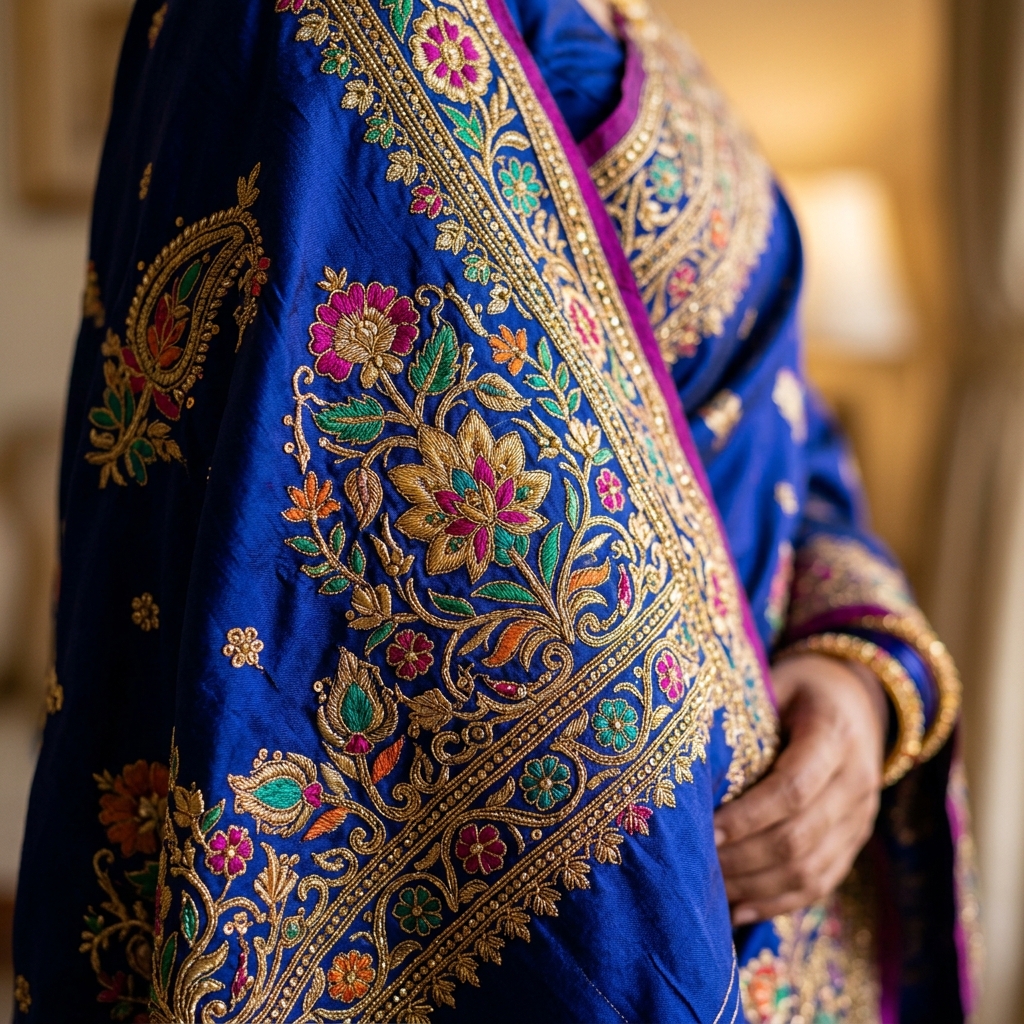
Updated: June 2026 Detailing is where our heart lies at Saha Textile. In an era dominated by rapid computer-programmed machine stitching that easily unravels, genuine hand-embellished textiles stand as a rare luxury. Our curated embroidered sarees feature hand-stitched motifs ranging from traditional organic florals to sharp geometric patterns, each telling a unique story of specialized craftsmanship and artistic patience. Since 1986, we have maintained a dedicated production network that utilizes premium-grade threads engineered to retain their rich luster and tensile strength over decades. Each premium piece is the direct result of weeks of focused labor by skilled local artisans who have dedicated their lives to preserving this heritage craft. Operating from our multi-level flagship showroom and production units at the Champadali crossroads in Barasat, we provide uncompromised textile transparency for your milestone investments. Indian embroidery holds a diverse structural history that shifts dynamically by region—spanning from the delicate shadow-work of Lucknow's Chikankari to our native, running-stitch heritage of Bengal’s Kantha, and from the heavy metallic relief of Agra’s Zardozi to the vibrant, light-reflecting mirror work of Gujarat. At Saha Textile, we deliberately unify these regional lineages. Our in-house master artisans employ an array of classic execution techniques, including precise hook-guided Aari work, intricate glass beadwork, hand-tacked sequin alignment, and tight dimensional French knots. Because these designs are manually executed directly onto the base frame, no two hand-stitched panels are ever entirely identical—giving you a truly one-of-a-kind garment. With mass-produced, high-speed automated machine embroidery flooding standard regional markets, our senior store curators recommend conducting these three technical quality audits right at the retail counter: Flip the embroidered panel over to analyze the reverse side of the stitching pattern. Genuine hand embroidery features minor, slight variations in stitch length and reveals tiny, manually secured thread knots where the artisan finished a thread run. Automated machine embroidery, conversely, displays a completely uniform, flat, and perfectly clipped nylon micro-mesh grid on the back, which can feel abrasive against the skin. Lay the saree flat and run your palm over the embroidered motifs. Artisan handwork features balanced, flexible tension that allows the base silk or cotton fabric to drape naturally. High-speed industrial machines punch threads with rigid, unyielding force, which often causes the surrounding base fabric to pucker, ripple permanently, or pull taut around the borders. Closely compare repetitive motifs, such as consecutive floral petals along the border. Computerized embroidery replicates shapes with absolute, mathematical uniformity. Human hand-embellishment will always register microscopic differences in stitch angle, yarn density, or placement—the definitive structural fingerprint of a living craftsman. Styling an intricate embroidered saree requires a careful aesthetic balance to highlight the needlework without crowding your silhouette: Heavy needlework places localized structural weight on base fabrics. To prevent thread snagging, fiber distortion, or premature color fading, follow this precise preservation routine:The Fine Art of Embroidered Sarees: A Master Curator’s Guide to Spotting Authentic Needlework
A Pan-Indian Needlework Heritage under One Roof
3 Technical Inspections to Spot Authentic Hand Embroidery
The Reverse Side Uniformity Audit
The Thread Tension and Fabric Distortion Test
The Symmetrical Imperfection Check
The Environmental Styling Playbook
The Technical Care and Conservation Protocol
Embroidery Class
Laundering Standard
Storage and Hanger Protocol
Heavy Zardozi, Beadwork, & Sequin Work
Strictly professional dry cleaning only. Never expose to home washing machines or aggressive detergents.
Never hang long-term; the weight of the metallic threads will warp and tear delicate base silks. Wrap inside unbleached muslin cloth and store flat.
Light Hand-Loomed Kantha & Fine Aari
Gentle manual hand wash in cold water using a mild, pH-neutral liquid cleanser. Do not wring, twist, or scrub.
Line dry completely flat in an indoor, well-ventilated, shaded space. Direct sunlight will permanently fade organic thread dyes.